MasteryTalk PRO
Founder Project · End-to-End Product Ownership
Project shown under NDA · Real assets can be shown on a videocall.
An AI-powered communication coach for nearshoring professionals — a 90-day program with immersive voice simulations, executive feedback, and a WhatsApp spaced-repetition coach. Built from zero across every layer: product strategy, business model, design system, and a working MVP.
Product strategy, 3-tier pricing model, ~600-line product spec governing every decision, design system in Tailwind v4, FSD architecture, Spec-Driven Development. AI tools (Claude Code, Cursor, Figma Make) for ideation, prototyping and MVP acceleration — integrated with Stripe, Twilio, OpenAI GPT-4o, Gemini, Azure Speech, Supabase.
The point isn't "I'm an engineer." The point is: I can take a product from spec to a working, testable MVP — and design decisions get validated in real conditions, not static mockups.
→ masterytalk.pro · MasteryTalk PRO is a work in progress, early access available on request.
Designing a 90-day transformation, not another English app
The brief
MasteryTalk PRO is a professional communication simulator for tech professionals across LATAM who already speak English but feel their delivery isn't at the level their position demands. It is sold as a structured 90-day program with a measurable outcome — moving the user from B2 to C1 on the CEFR framework.
The market gap
Demand for LATAM tech talent in US companies is at historic highs — 76% of US firms already employing nearshore talent plan to hire more in 2026. But the EF English Proficiency Index 2026 places Colombia, Brazil and Mexico in the Low band. World-class technical talent. English in low band. The bottleneck isn't talent — it's communication under pressure.
The product reframe
The category is saturated with English apps that treat the problem as missing knowledge — Duolingo for gamification, Babbel for content, Talaera for human tutors. For a senior developer leading retros with US clients, the gap isn't vocabulary; it's authority under pressure. The product was reframed not as another English app, but as a professional communication simulator with a measurable outcome.
The design problem
Translating that reframe into a coherent system meant orchestrating five paths, fifty micro-lessons, a war room, a WhatsApp coach, transactional and marketing email — features that would normally fragment any product.
The challenge wasn't building the features — it was making them feel like one program, not a feature buffet.
Three tensions that shaped every decision
Three tensions. Before designing a single screen, I audited the full spec to find where the system could break. Three structural tensions surfaced — each one capable of dissolving the program promise if resolved poorly. They became the lens for every screen, every microcopy decision, every state transition.
Personalization vs. cognitive load
The product collects rich signal at intake — pillar scores, context, profession. But every feature that uses that signal adds cognitive surface for the user. Visible logic becomes work. Invisible logic stops being perceived. Personalization had to be felt, not explained.
Program structure vs. urgency
A 90-day program needs sequence to deliver outcomes. But real users have an interview tomorrow and a presentation in two days. Strict gating breaks trust. Open access breaks the program. The system needed two parallel logics — structured progression AND an urgency valve — without either feeling like a workaround.
High-stakes practice vs. emotional safety
The session is the product's core loop. It needs enough pressure to simulate a real interview or sales call. But too much pressure on session 1 sends the user back to Duolingo. Pressure had to ramp — Support, Guidance, Challenge — in a way the user opts into rather than gets pushed through.
Four decisions that hold the program together
The free session is the product, not a demo
Resolves Tension 1 — Personalization
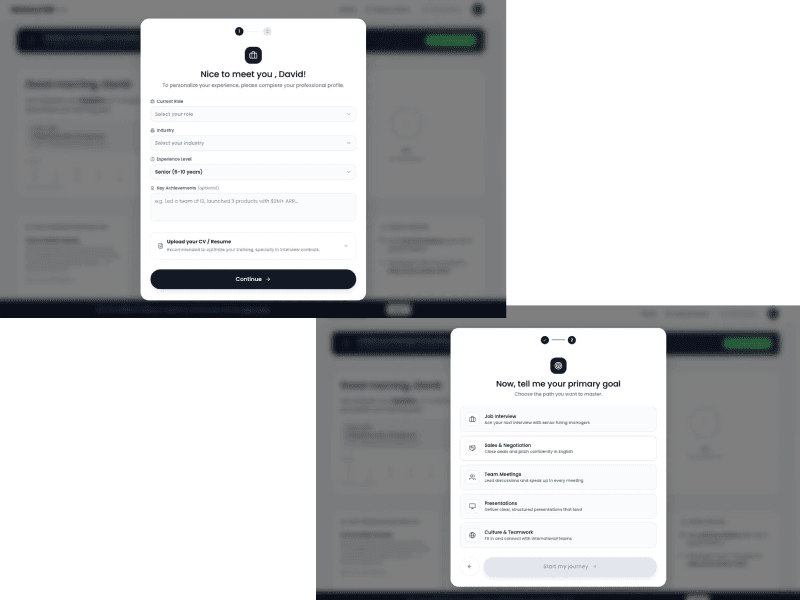
The free Self-Introduction Warm-Up runs the exact same session engine as every paid path — same screens, same Strategy framework, same Context selection, same voice practice, same feedback. The user doesn't experience a preview. They experience the product, with one scenario unlocked. Pillar scores, context, and profession data flow into Primary Path recommendation without the user ever filling a form. The work that earned the recommendation IS the warm-up.
War Room as parallel logic, not exception
Resolves Tension 2 — Urgency
War Room sits alongside the Primary Path with its own button in the header — visually and architecturally separate. Five sessions per month, any scenario, immediate access. The framing is deliberate: not 'free practice' but urgency release valve — for the interview tomorrow, for the experienced user who wants unstructured reps. It protects the structured program and protects trust.
Pressure as opt-in, not forced ramp
Resolves Tension 3 — Emotional Safety
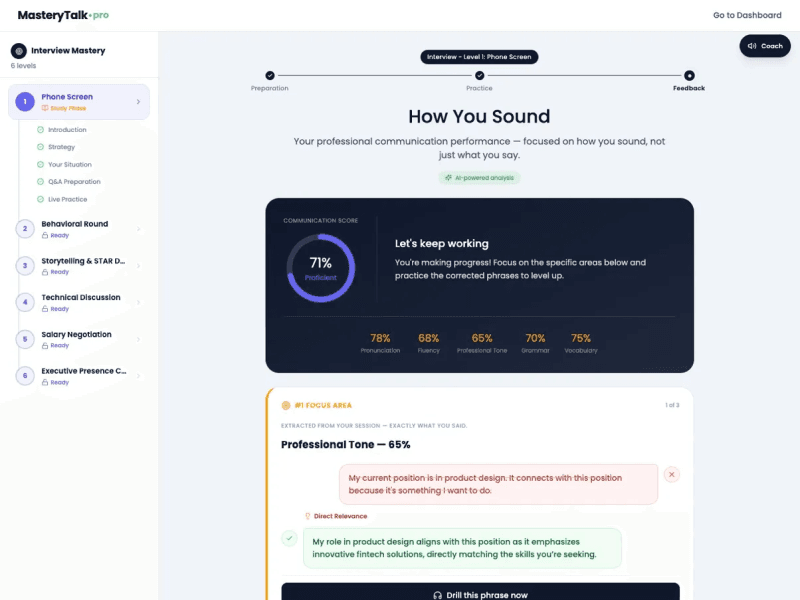
Hints render collapsed by default — active recall, not passive reading. Challenge Mode is a toggle the user activates for themselves: no hints, no prep, exactly like the real thing. Combined with arena phases that ramp Support → Guidance → Challenge within each session, pressure becomes a tool the user controls.
Habit infrastructure across three surfaces
Cross-cutting — Retention
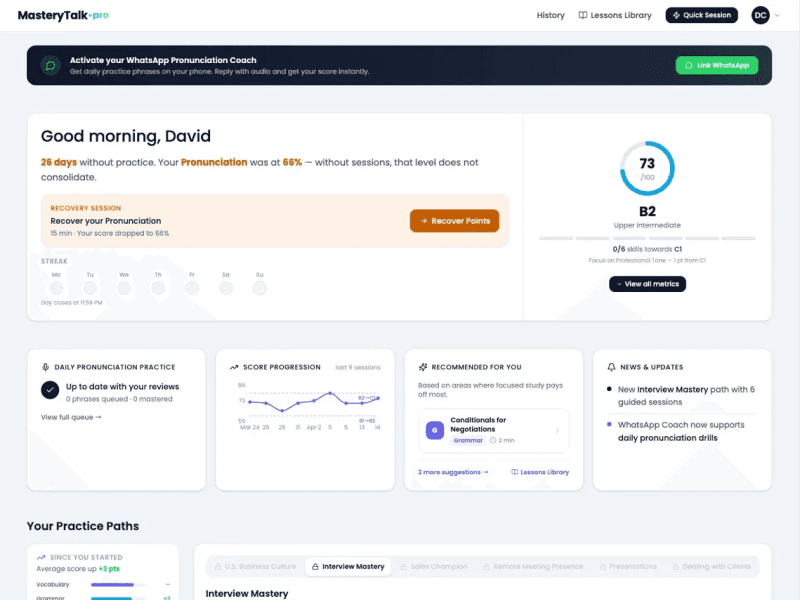
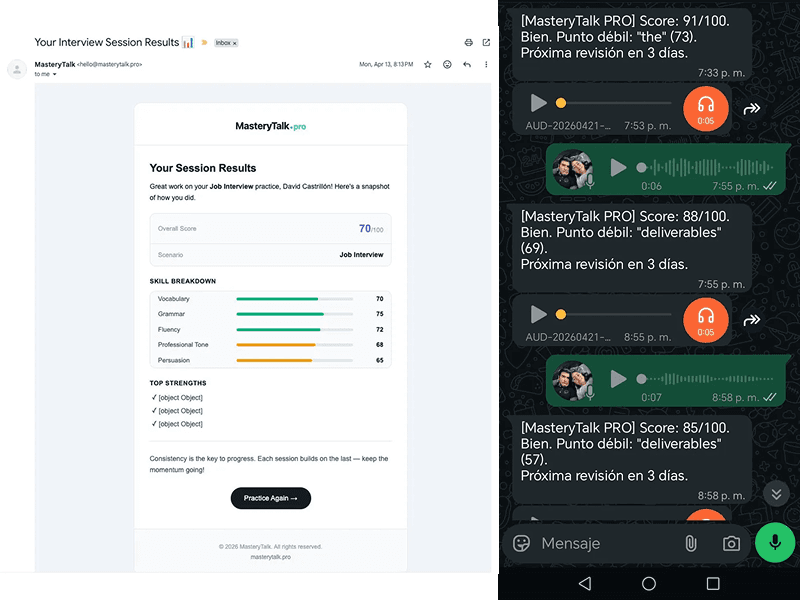
Retention isn't built in the app alone — it's built in the interstitial spaces between sessions. Three coordinated channels reinforce one loop: streak grid + recommended-next on the dashboard (loss aversion), WhatsApp SR Coach (daily 30-second pronunciation challenge with TTS reference + Azure scoring), and lifecycle email (post-session ROI summary, not invoice). The habit forms across the user's day.
What the program looks like at every layer
The program runs across four moments — intake, dashboard, session, interstitial. Each one is engineered to reinforce the same loop: practice, feedback, measurable progress. What the user sees, in order:
A program that holds together — and what it taught me
What shipped
Primary Path / Advanced / Mastery progression with progressive unlocking. War Room as urgency valve. WhatsApp SR Coach with TTS reference and Azure pronunciation scoring. Dual-axis lesson engine across 50 micro-lessons. Five paths × six levels with 6-pillar CEFR-aligned feedback. Lifecycle email integrated across Resend (transactional) and Loops (marketing).
The design wins
Personalization is felt, not explained — the user never sees a form asking what they want to learn. Pressure is opt-in through Challenge Mode and Arena phases — the user controls intensity, the product calibrates to it. The program reads as one program, not a feature buffet — every surface reinforces the same loop without competing for attention.
What I'd revisit
The dashboard still shows too much for a brand-new user. Empty states educate but density on day 1 is high. A first-visit mode that collapses everything except Hero + Start Warm-Up CTA is on the roadmap. The renewal email is currently transactional; converting it to a monthly progress report closer to a Spotify Wrapped per cycle is the highest-leverage retention bet I haven't shipped yet.
How to design a product where the user's own progress is the primary content. The architecture isn't a catalog to organize — it's the user's trajectory through 90 days.
DALOG
Industrial IoT · Equipment Health Monitoring