DALOG
Industrial IoT — Equipment Health Monitoring
Project shown under NDA · Real assets can be shown on a videocall.
DALOG is a German company with 30+ years in condition monitoring for critical industrial machinery. Their platform — used by reliability engineers in mining, cement and metals — turns vibration, electrical and process data from heavy machinery into actionable diagnostics.
Abnormal vibration is a symptom — DALOG focuses on the why, not just the alarm.
Redesign of the core monitoring UI — turning dense sensor data into clear, decision-ready interfaces. End-to-end user flows for Equipment Health 360. Multi-sensor and wireless monitoring views — designed to eliminate the silos between mechanical, electrical, automation and process domains. DALOG's customers don't get a second chance with a failed crusher or kiln.
When the data is critical, the interface can't be in the way
The brief
DALOG has been monitoring the health of critical industrial machinery for over thirty years. Their platform turns vibration, electrical, and process signals from the machines that run mines, cement plants, and metal works into actionable diagnostics. When a crusher fails or a kiln drifts out of spec, the cost isn't measured in inconvenience — it's measured in stopped production and downstream supply chains.
The product worked. The data was there. What wasn't working was the path between the two.
Data analysts — DALOG's primary users — were spending too much cognitive effort navigating the system to find what they needed, rather than interpreting what they found. The information architecture had grown organically across years of feature additions. Core diagnostic workflows had become indirect, inconsistent, and slow.
The mandate
The director of data engaged me with a dual brief: simplify the existing experience, and make room for the new capabilities the platform needed. Not a cosmetic refresh — a reorganization of how analysts find, interpret, and act on signals, paired with a visual language to make new features feel native instead of bolted on.
The terms of engagement
Ten months. Co-creation with the stakeholder who knew the data and the users best. A domain dense enough that I had to learn it before I could redesign anything.
Working without direct user access
Discovery method
In an ideal world, I'd have shadowed reliability analysts in cement plants and mining operations. The reality of enterprise B2B — especially with users distributed across remote industrial sites — is that you rarely get that access. So discovery looked different.
The director of data became the primary research channel. Three decades of monitoring critical machinery had given DALOG deep institutional knowledge of how analysts work — what they look at first, where they get stuck, which decisions they make alone and which they escalate. My job was to extract that knowledge and turn it into design decisions.
Domain immersion
Industrial diagnostics isn't a domain you can fake. Vibration, electrical signatures, process parameters — each tells a different part of the story of a machine's health, and analysts cross-reference all three to make calls that protect millions of dollars in production capacity. Before redesigning anything, I worked through DALOG's technical documentation in detail, mapped how raw sensor data becomes a diagnostic conclusion step by step, and audited the existing platform end-to-end — identifying every place where the path from data to decision had unnecessary friction.
The platform constraint — Microsoft Fluent
The challenge wasn't "what should this look like?" — it was: how do you take a sophisticated design system built for general enterprise software and make it serve the specific cognitive load of industrial diagnostics, without breaking the system or fighting it?
Three decisions that shaped the engagement
Build a foundation that supports multiple ways of working
The director wanted new features. But every time I traced where a new feature would live, the answer was "it depends — analysts have to navigate through three different sections to get there." The IA wasn't ready for what was coming.
A layered architecture — one dominant entry path for the daily workflow, with parallel routes preserved for asset-centric and domain-centric work. The IA stopped pretending to be one tree and became something closer to a navigable space.
I didn't try to fix every navigation issue at once. The reorganization prioritized workflows analysts ran daily. Lower-traffic surfaces inherited the new patterns later.
Unify sensor data on one canvas, not three
Vibration, electrical signals, and process parameters lived in separate parts of the platform. Each made sense alone. But analysts make diagnostic calls by cross-referencing all three — and the platform forced them to assemble that picture in their heads.
A unified dashboard where the asset is the constant and the sensor view is the variable. Analysts stay on one screen, in one machine's context, and switch between vibration, electrical, and process readings without losing their place.
I didn't try to make every sensor's full detail fit on the unified view. Deep dives still had dedicated surfaces. But the first answer to "how is this machine doing?" now came from one place.
Design new capabilities as natives of the existing flow
The director's roadmap included new analytical and reporting capabilities. The temptation with new features in a maturing platform is to make them feel "new" — visually distinct, separately accessed, marked as "premium."
Embedded. The new capabilities became answers inside existing analyst workflows — appearing where the user was already looking, not in a new section to discover and learn. By using Fluent's existing patterns, they didn't need to scream "I'm new." They just worked.
Marketing visibility. The new capabilities weren't merchandised as separate "premium" features. The novelty was in the capability, not the chrome.
What ten months of work was reorganizing
DALOG legacy home — original IA
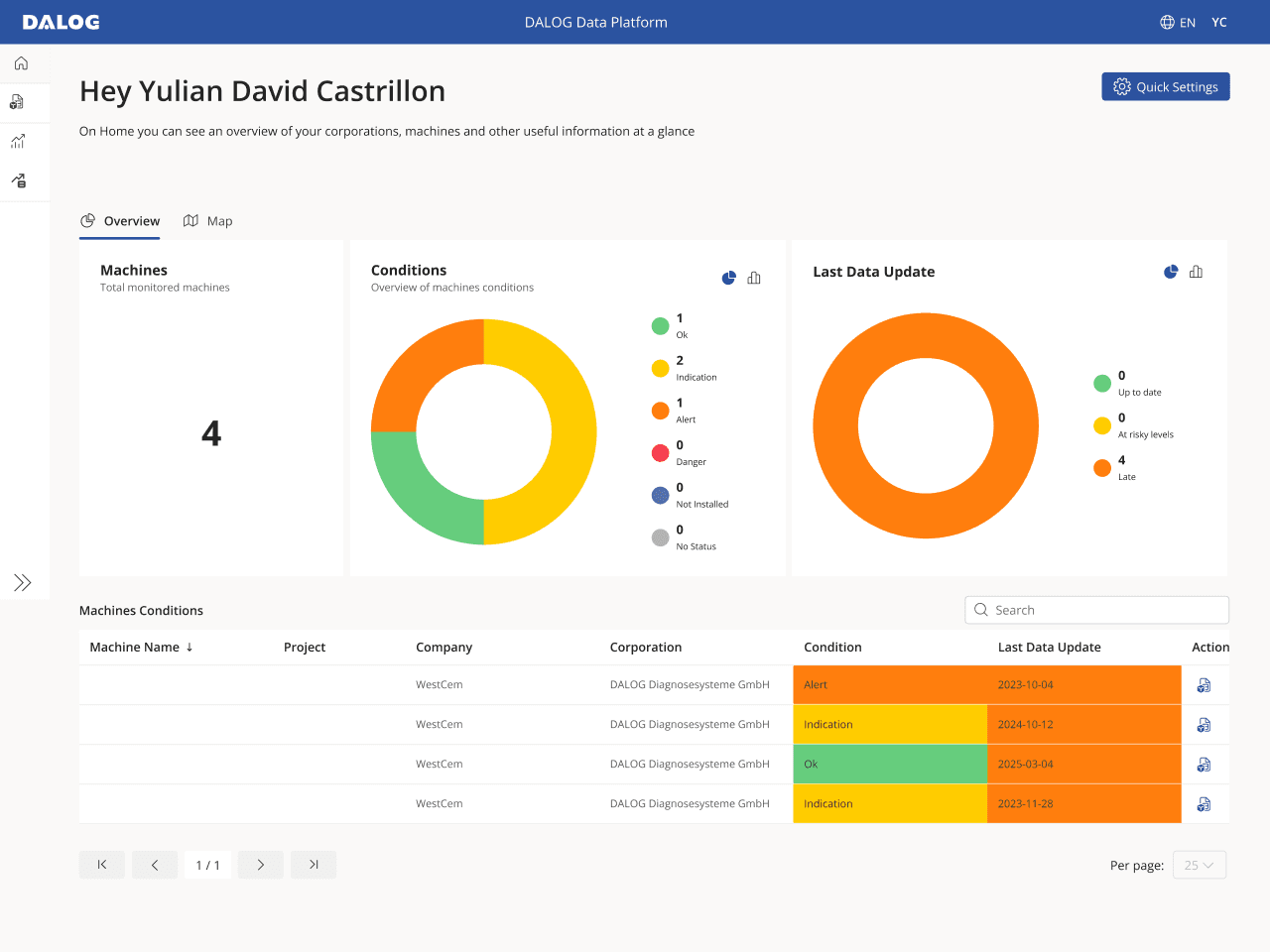
IA fragmented across parallel modules
Years of feature additions had grown a navigation that didn't reflect how analysts actually move through the platform. Workflows crossed module boundaries; the menu structure didn't.
Sensor data lived in silos
Vibration, electrical signals, and process parameters had separate destinations. Cross-referencing — the core analytical move — required leaving and re-entering different parts of the platform.
Daily workflows required cross-screen navigation
Tasks analysts performed every shift were buried multiple clicks deep across multiple sections. The system had been built for completeness, not for the rhythm of the work.
From alert to diagnosis, on one platform.
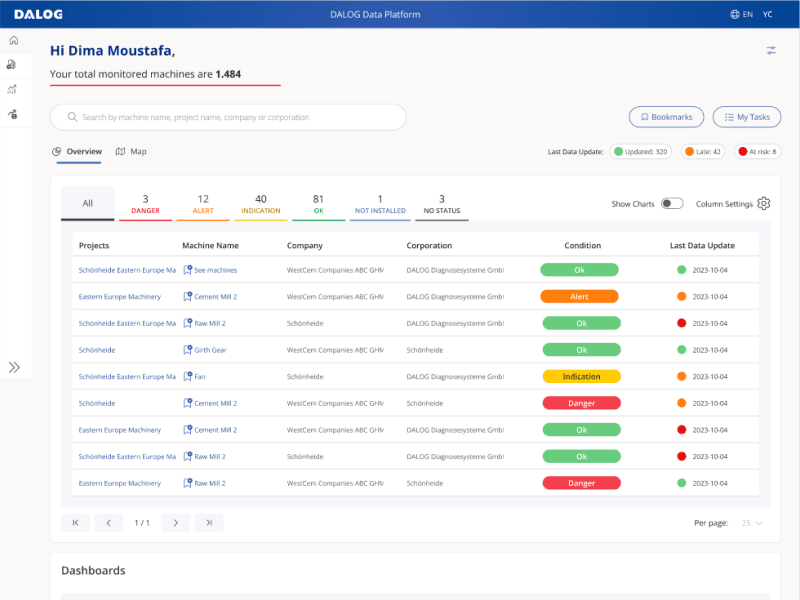
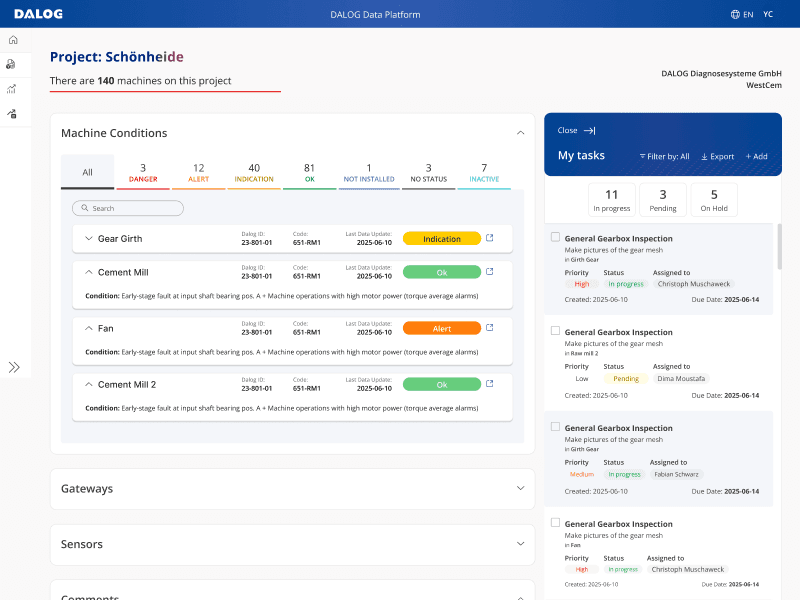
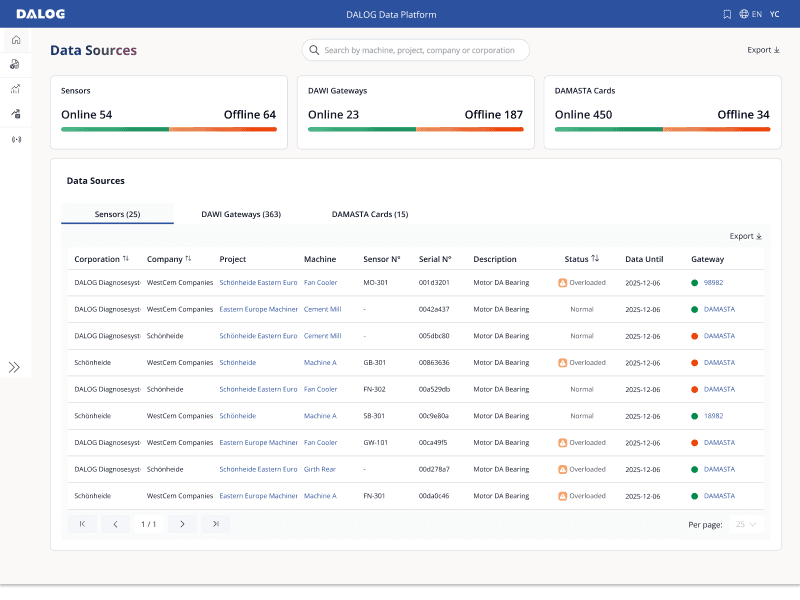
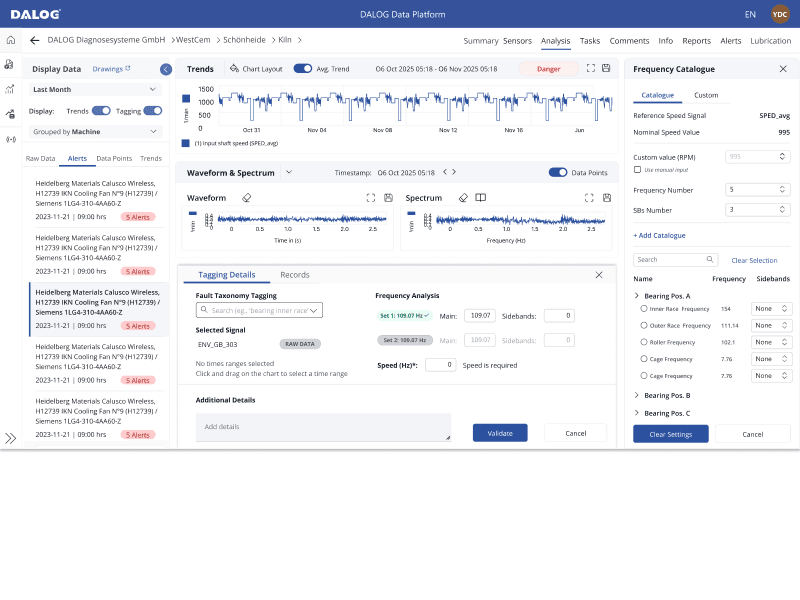
The asset stays constant. The sensor view becomes the variable. Cross-referencing happens in the user's head — but with all inputs already in front of them, not buried two clicks away.
Turning three decades of institutional knowledge into a system newer analysts can navigate
Where it stands
Ten months of work delivered. The redesigned platform — new IA, unified dashboard, embedded capabilities — was handed off to DALOG and is currently awaiting release. Release is on the client's timeline, not the design timeline. That's how enterprise B2B works, and how it should work. The platform serves operations that can't tolerate disruption, so go-live happens when the client says it does.
What I'd do differently
The constraint of no direct user access was real and not unusual in enterprise B2B. But if I were to do it again, I'd push harder for at least three structured sessions with actual analysts during the design phase, even brief ones. The director of data was an excellent proxy. But proxies have blind spots, and three hours with end users would have stress-tested the IA decisions earlier — in design, not in QA.
What carries forward
The patterns I built for DALOG aren't industrial-diagnostics-specific. Layered IA for multiple workflows, the constant-asset / variable-sensor canvas, embedded capabilities over bolted-on features — they're how you design for any platform where users need to cross-reference distinct information types under cognitive pressure.
Make sophisticated workflows legible to people who haven't yet earned all the context. That's the platform-design challenge in a sentence.
Zilliant
Salesforce + SAP-integrated B2B SaaS